Last Friday I noticed a new sculpture in the quad. Then I saw another, not too far away. What’s going on here? Could it be…
Pronounce the dot.
Last Friday I noticed a new sculpture in the quad. Then I saw another, not too far away. What’s going on here? Could it be…
A friend recently commented on how our country is politically polarized. Yes, I feel that — but I also feel that many of us are apathetic and alienated from the political process.
How could these both be true? It seems contradictory, paradoxical.
Perhaps the answer, or part of it, has to do with our narrowly circumscribed political dialog. I’ve been puzzling over how to better express the idea.
Say you’re looking at two marks on a wall. If you’re standing very close, with your nose practically touching the plaster, you will see the two marks as rather far apart. But if you stand back and look at the whole wall, you might say that that the marks are quite close together.
Or take a bar graph. It’s a well-known fact that if you chop off the bottom of a bar graph you can exaggerate differences and make them seem bigger. There’s a whole chapter on this in How to Lie with Statistics.
Or say you listened to nothing but grandpa’s record collection. You might think dixieland and bebop represented the absolute opposite ends of the musical spectrum. And you’d be right, insofar as 1940s jazz was concerned.
All of these seem like variations on the same phenomenon. This has surely been observed and documented by those who study human cognition. What’s vexing me is I can’t think of the name for it. The only term I’ve encountered that seems to make sense is “truncated scale,” but that’s hardly ubiquitous.
Anyway, my theory is that some of us are “zoomed in” on two marks on the wall.
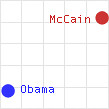
From this close view, the differences are vast and passions run high. There is a sense of polarization between these two diametrically opposed points.
Male Employee: I sure do like a short woman. Xy: Well, my husband is 6’4″. That cooled his jets for a bit. But then he…
What a month it’s been. You came down with your first bug a few weeks ago; you’ve still got a cough and a runny nose,…
I was talking to Howie and he shared this passage with me: Education is now prized not because the culture values truth and wisdom, or…
The neighbor kids are always knocking on our door. The reasons seem to come and go in waves. Most recently my wrench has been enjoying…
I was recently contacted by the good folks at Open Sound New Orleans. This is a website where people can post audio clips to a…
“All two-valued systems are false.” — Gene Wolfe
Consider the left-right continuum of political thought. It often strikes me as tired and played-out. Yet at other times it seems quite relevant. It certainly is one-dimensional, by definition, and thus it can’t begin to reflect the rich variation and nuances of political philosophy. For example, Nazis and Bolsheviks would be at opposite ends of this spectrum, but don’t they have a lot in common? Something important is missing.
At some point during my undergraduate years, a professor introduced me to a dual-axis model of politics. It doesn’t abandon the well-known left-right continuum. It simply adds another dimension, call it an up-down continuum. Up represents a more authoritarian tendency; down represents the opposite inclination, which might be called libertarian. (Note the small “l” to avoid confusion with the Libertarian Party.) I’m not sure, but I think this model may have first been articulated by the famous psychologist Hans Eysenck.
The result looks something like this:
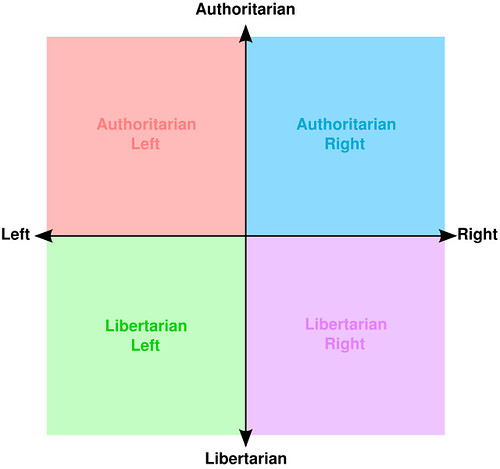
This clears up some things. Hitler and Stalin would both be at the top of the chart, but in opposite corners.
Of course you could get even more complex. You could add an urban-rural axis or a pacifist-militant axis, to name just a couple. But that quickly gets cumbersome. This dual-axis model seems to work pretty well for me. I’ve carried this mental construct around for the last twenty years, and I find it helpful. I just wish more people knew about it.
Well, turns out there’s a website that allows you to take a short quiz and plot yourself on this model. No, I’m not talking about The World’s Smallest Political Quiz. I’m referring to The Political Compass.
If you haven’t already done so, hie thee to their website and take the test. See where they map you. Does it correspond with where you’d have plotted yourself?
Since I didn’t get to sound off on these issues on the radio, maybe I’ll just give vent here.
I watched all four of the so-called debates. Mostly they were pretty boring. I thought the last one was the most interesting, but all in all they were disappointing.
The debates frustrate me. Once upon a time they were run by a non-partisan group, the League of Women Voters. But for the last twenty-odd years they’ve been put on (and we’ve all been put on) by a bipartisan commission. The debates are controlled by the two major parties — two of the most powerful political entities in the world — and as one might expect, they are constructed to serve the interests of those parties.
And, face it, those parties are old and entrenched. Yet they’re both trying to sell a message of change. The mind boggles. But I digress.
What frustrates me in the debates is what frustrates me in our national political dialog: The scope is too narrow. The dialog is so tightly circumscribed that we have come to examine and contrast minute differences of policy between Democrats and Republicans, magnifying these differences so greatly that it’s easy to forget that there is a much wider range of possibilities.
To some extent this magnification is justified. The Presidency of the United States is perhaps the most powerful office in the world. I acknowledge that even the smallest differences can have huge effects on all of us.
But surely we are impoverished by not allowing a broader range of political dialog.
WWL 870-AM is broadcasting from our campus today. The office of University Media Relations asked me to sit in for a while, so I did.…
This Beetle Bailey strip ran a couple weeks ago and caught my eye for a couple reasons. 1) Beetle and Plato appear to be under…
After this past weekend, I am massively frustrated with ACORN. You know ACORN, the Association of Community Organizations for Reform Now. They’ve been in the…
I am under sonic assault.
Meant to post this mix yesterday. This music captures the mood of the meltdown, I think. Enjoy.
Back in June 2006 we had some extra money lying around from our insurance settlement. I’m hesitant to name dollar amounts publicly. Let’s just say…
Again this morning with the non-starting car. I think this is the second time since I wrote about this problem back in January. Plenty of…
I suppose most people take political rhetoric with a grain of salt, which is certainly advisable. But I also notice a lot of people get…
Our dishwasher wasn’t draining properly. Since we got it less than a year ago it’s still under warranty. So Sears sends out a service technician.…
Pomegranates are back in season. I picked up a couple at the store this past week and peeled one for breakfast this morning. Delicious. Of…