Herb and Jenny are spending the night, along with their kids Marlon and Leroy, as they pass through New Orleans. We walked up to Venezia…
Pronounce the dot.
Herb and Jenny are spending the night, along with their kids Marlon and Leroy, as they pass through New Orleans. We walked up to Venezia…
One of the key tensions in my relationship with Xy has to do with television. To put it bluntly, she’s for it and I’m against…
As of this moment, a bit of doggerel I wrote last year is the number one search result in Google for “christmas eve poem.” (Update:…
Against my better judgment, I’ve set up a new site for the podcast known as J&B’s Nightcap. It’s at nightcap.rox and the second installment is…
I upgraded this blog (and a few others) to WordPress 2.7 “Coltrane” today; it’s a great package, but the built-in upgrade installation feature is simply…
I’ve been working over the past few months to get a new podcast launched here at work, and I think we’ve finally gotten to the point of promoting it. Here’s our formal announcement, more comments follow.
The Center for the Advancement of Teaching (CAT) at Xavier University of Louisiana is pleased to announce the official launch of our new podcast series, Teaching, Learning, and Everything Else.
Each episode is a conversation with a teacher in higher education, in which we examine how teaching intersects with a diverse range of topics. So far we have completed four episodes and touched on issues relating to technology, service learning, master teachers and dealing with personal problems of students. But we’re just getting started, and hope to continue branching out and exploring new topics with each episode. It’s a fresh and personal approach to faculty development that will appeal to anyone who teaches at the college level, regardless of discipline or rank.
The series is produced by Bart Everson, Media Artist at CAT. Dr. Elizabeth Yost Hammer is the Director of CAT and host of the show.
For more information, and to listen to the show, please visit our website at cat.xula.edu/podcast
Here we go again. It was probably the coldest morning of the season so far. No crank, no start. Xy was pissed, and I can’t…
Three cheers for Steve Volan. He’s blogging again. He’s writing about a hot topic in New Orleans. And he’s the only person on the City…
Whenever something happens to one of our cellphones, it precipitates drama. I guess it’s an unanticipated side-effect of not having a landline. Anyway, Friday was no exception. When T-Mobile confirmed my phone was busted beyond repair, I decided it was time to join Xy on Verizon. By complete coincidence, Friday was the day the Blackberry Storm rolled out, RIM’s answer to the iPhone, available only thru Verizon. The Verizon website was basically unusable. Luckily when I drove out to the store, the storm had passed, so to speak.
Alex, Just wanted to let you know what’s up with this old Mac. I’ve ended up taking it in to work in order to get…
I was recently contacted by the good folks at Open Sound New Orleans. This is a website where people can post audio clips to a…
“All two-valued systems are false.” — Gene Wolfe
Consider the left-right continuum of political thought. It often strikes me as tired and played-out. Yet at other times it seems quite relevant. It certainly is one-dimensional, by definition, and thus it can’t begin to reflect the rich variation and nuances of political philosophy. For example, Nazis and Bolsheviks would be at opposite ends of this spectrum, but don’t they have a lot in common? Something important is missing.
At some point during my undergraduate years, a professor introduced me to a dual-axis model of politics. It doesn’t abandon the well-known left-right continuum. It simply adds another dimension, call it an up-down continuum. Up represents a more authoritarian tendency; down represents the opposite inclination, which might be called libertarian. (Note the small “l” to avoid confusion with the Libertarian Party.) I’m not sure, but I think this model may have first been articulated by the famous psychologist Hans Eysenck.
The result looks something like this:
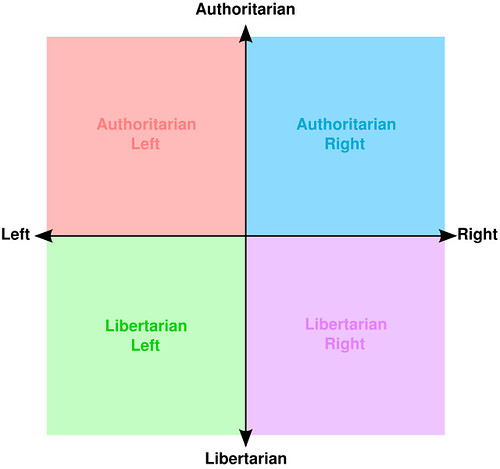
This clears up some things. Hitler and Stalin would both be at the top of the chart, but in opposite corners.
Of course you could get even more complex. You could add an urban-rural axis or a pacifist-militant axis, to name just a couple. But that quickly gets cumbersome. This dual-axis model seems to work pretty well for me. I’ve carried this mental construct around for the last twenty years, and I find it helpful. I just wish more people knew about it.
Well, turns out there’s a website that allows you to take a short quiz and plot yourself on this model. No, I’m not talking about The World’s Smallest Political Quiz. I’m referring to The Political Compass.
If you haven’t already done so, hie thee to their website and take the test. See where they map you. Does it correspond with where you’d have plotted yourself?
Since I didn’t get to sound off on these issues on the radio, maybe I’ll just give vent here.
I watched all four of the so-called debates. Mostly they were pretty boring. I thought the last one was the most interesting, but all in all they were disappointing.
The debates frustrate me. Once upon a time they were run by a non-partisan group, the League of Women Voters. But for the last twenty-odd years they’ve been put on (and we’ve all been put on) by a bipartisan commission. The debates are controlled by the two major parties — two of the most powerful political entities in the world — and as one might expect, they are constructed to serve the interests of those parties.
And, face it, those parties are old and entrenched. Yet they’re both trying to sell a message of change. The mind boggles. But I digress.
What frustrates me in the debates is what frustrates me in our national political dialog: The scope is too narrow. The dialog is so tightly circumscribed that we have come to examine and contrast minute differences of policy between Democrats and Republicans, magnifying these differences so greatly that it’s easy to forget that there is a much wider range of possibilities.
To some extent this magnification is justified. The Presidency of the United States is perhaps the most powerful office in the world. I acknowledge that even the smallest differences can have huge effects on all of us.
But surely we are impoverished by not allowing a broader range of political dialog.
Here’s some more webstats for this blog. That September 1st peak is when Gustav made landfall, and it’s been downhill ever since. Apparently I need…
Here’s the top ten referrers to this blog since, um, well whenever it was I installed this new stats package. adrastos.blog-city.com 274 michaelhoman.blogspot.com 185 librarychronicles.blogspot.com…
I first heard the phrase “digital natives” at the New Media Consortium’s 2007 Regional Conference. I enjoyed the conference a great deal and found the…
I’ve been playing around with a relatively new music-sharing website called 8tracks. It allows you to create and share playlists legally. Here’s a silly little…